



Submit a Paper
The List of Accepted Papers is available here.
If you would like an invitation confirming authorship on an accepted paper on IEEE AP-S/URSI 2026 letterhead in order to begin the travel-visa application process, you may request such a letter by clicking on the link below. Invitation Letters will be sent by email at no cost.
Request an Invitation Letter (confirming authorship on an accepted paper)
General Submission Information
All paper and abstract submissions must be received in PDF format via this web site on or before
Friday, 23 January, 2026 Friday, 6 February, 2026 (23h 59m at International Date Line; UTC-12 hours); this is equivalent to 6h 59m on 7 February, 2026 Eastern US Time.
This is a firm deadline. Papers will not be accepted after this date. Only electronic submissions in PDF format will be accepted. Please consult this web page for the latest instructions, templates, and format examples. Please do not include page numbers on submitted documents. All papers must be written in clear, idiomatic English. Papers that are not presented at the conference (i.e. no-show papers) will be excluded from IEEE Xplore (they will be removed from the proceedings before the proceedings are submitted to IEEE Xplore). Address all AP-S and URSI correspondence, including inquiries concerning papers, the technical program, and copyright forms, to papers@2026.apsursi.org.
For an accepted paper to be listed in the technical program, one of the authors of the paper must be registered. Authors may only register against a maximum of 2 papers. If an author has received acceptance for more than 2 papers it is recommended that a co-author registers against those papers to limit the number of presentations required by the same author. Each author/co-author must register separately. In the event that this is not possible due to funding or visa issues, another registered attendee must be identified to serve as presenter.
he language of the symposium is English. Each document that you submit (one-page abstract or 2 page paper for URSI; one-page abstract or 3-4 page summary for AP-S) should be formatted exactly as indicated in the corresponding template. (The templates are already written with the correct formatting, so replacing the text in the templates with your own text is an easy way to use the templates.) Please do not include page numbers on your submitted documents.
A signed (electronically) IEEE copyright form or URSI Publication Agreement must accompany accepted papers. IEEE Copyright forms will be collected for accepted papers after the notices of acceptance have been sent to authors.
Papers that are not presented at the conference (i.e. no-show papers) will be excluded from IEEE Xplore (they will be removed from the proceedings before the proceedings are submitted to IEEE Xplore).
Requirements
There are two submission options for 2026 AP-S papers; authors must choose one of the two options. The submission may be either in one-page, single column or minimum of 3 pages and maximum of 4 pages in length, including text, references, and figures.
- Submissions that are one page in length must be formatted in a single column per the provided AP-S template.
- One-page papers will not be included in the IEEE Xplore.
- Submissions that are one page, but in 2-column format, will be automatically rejected.
- Submissions that are 3-4 pages in length must be formatted per the provided template.
- The content of the 3-4 page paper should substantially fill up the pages—Do not make it much shorter than 3 full pages.
- Submissions must be in IEEE 2-column format. Submissions that are 3-4 pages, but in single-column format, will be automatically rejected.
- By default, 3-4 page papers will be submitted to IEEE Xplore. Authors may optionally choose not to include the paper in IEEE Xplore.
- The introduction of the paper should clearly indicate the unique aspects of the submission and how it relates to previous work.
AP-S authors should choose between a one-page abstract or a 3-4 page paper for each submission. Submitting both formats for the same paper is not allowed.
Templates for 1 Page AP-S Submissions
- MS Word Template (APS_1pg_2026_template_MSWord.docx)
- PDF generated from MS Word file (APS_1pg_2026_template_MSWord.pdf)
- LaTeX Template (APS_1pg_2026_template.tex, APS_1pg_2026.cls)
- PDF generated from LaTeX file (APS_1pg_2026_template.pdf)
Templates for 3-4 Page AP-S Submissions
- MS Word Template (APS_3-4pg_2026_template_MSWord.docx)
- PDF generated from MS Word file (APS_3-4pg_2026_template_MSWord.pdf)
- LaTeX Template (APS_3-4pg_2026_template_LaTeX.tex, IEEEtran.cls)
- PDF generated from LaTeX file (APS_3-4pg_2026_template_LaTeX.pdf)
Requirements
There are two submission options for 2026 URSI papers; authors must choose one of the two options. The submission may be either in one-page, single column format or in 2-page, 2-column format, including text, references, and figures.
- Submissions that are one page in length must be formatted in a single column per the provided template.
- One-page papers will not be included in the IEEE Xplore.
- Submissions that are one page, but in 2-column format, will be automatically rejected.
- Submissions that are two pages in length must be formatted per the provided template.
- Submissions must be in IEEE 2-column format. Submissions that are two pages, but in single-column format, will be automatically rejected.
- By default, 2 page papers will be submitted to IEEE Xplore. Authors may optionally choose not to include the paper in IEEE Xplore.
URSI authors should choose between a one-page abstract or a two-page summary for each submission. Submitting both formats for the same paper is not allowed.
Templates for 1-Page URSI Submissions
- MS Word Template (URSI_1pg_2026_template_MSWord.docx)
- PDF generated from MS Word file (URSI_1pg_2026_template_MSWord.pdf)
- LaTeX Template (URSI_1pg_2026_template.tex, ursi2026.cls)
- PDF generated from LaTeX file (URSI_1pg_2026_template.pdf)
Templates for 2-Page URSI Submissions
- MS Word Template (URSI_2pg_2026_template_MSWord.docx)
- PDF generated from MS Word file (URSI_2pg_2026_template_MSWord.pdf)
- LaTeX Template (URSI_2pg_2026_template_LaTeX.tex, IEEEtran.cls)
- PDF generated from LaTeX file (URSI_2pg_2026_template_LaTeX.pdf)
To foster active involvement of students and to ensure a future membership of highly qualified researchers in the IEEE Antennas and Propagation Society, the Society sponsors a Student Paper Competition at its annual Symposium. The complete Rules and Guidelines are available here. Questions about the competition should be e-mailed to the 2026 AP-S Student Paper Competition Coordinators (spc@2026.apsursi.org).
If you wish to participate in the student paper competition, check the appropriate box during the submission process so that you will be prompted to upload all of the required documents.
The first author must be a student (undergraduate, graduate) or postdoctoral researcher affiliated with a university or college. Collaborative work involving industry partners is encouraged but not required. Eligible submissions should present actionable and industry-relevant applications of antenna or electromagnetic technologies. These may include: a novel or enhanced technology concept with strong commercialization potential, a system or process improving performance, cost-effectiveness, or manufacturability, a business or market strategy built on antenna/EM innovation, and a concept demonstrating clear pathways to industry adoption or startup formation. Detailed instructions may be found here.
For additional information, contact jiangzhu@ieee.org.
If you wish to participate in the industry application idea pitch competition, check the appropriate box during the submission process.
To qualify for consideration in the Industry Paper Competition, at least one of the authors must be affiliated with a corporation or private company. Collaborative work between industry and research institutions (government and/or universities) is acceptable. Papers eligible for the Industry Paper Competition are those that describe, in contrast to basic research, a practical design or measurement procedure, a realizable integration technique, a process of enhancement and/or combination thereof that results in significant improvements in the performance and/or robustness of an antenna or electromagnetic related product or system. An eligible paper can also present the application of an antenna/EM technology/technique to a system that significantly benefits the AP society and community at large.
More information on the Industry Paper Competition web page.
If you wish to participate in the industry paper contest, check the appropriate box during the submission process.
To encourage paper submissions and dialogue relating to special topics of interest to the conference attendees, the conference will include a collection of special and celebratory sessions. Information on special and celebratory sessions is available herewill be posted here soon. If you are submitting a paper to a special or celebratory session, make sure to select the appropriate session during the submission process.
| Special Sessions | |||
|---|---|---|---|
| Advanced Numerical Modelling and Simulation of Metasurfaces | |||
| Advancements in Technology Based on Kildal’s Inventions: A Tribute to Prof. Kildal on the 10th Anniversary of His Passing | |||
| Advances in Implantable Antenna Design for Biomedical Treatment, Monitoring, and Wireless Power Transfer. | |||
| Advances in Millimeter-Wave Transceiver Front-End Technologies | |||
| Advancing Electromagnetics for Half a Century: The Impact of Research and Service of Professor Stuart A. Long | |||
| Celebrating Prof. John L. Volakis' 70th Birthday and Contributions to Antennas and Propagation | |||
| Celebrating the 20th Anniversary of EuCAP and EurAAP: Two Decades of Collaboration with IEEE AP-S | |||
| Challenges and solutions for using metasurfaces and metagratings in next-generation wireless communication and sensing systems | |||
| Channel Characterisation for Mobility | |||
| Channel modeling and antenna/array developments for UAVs | |||
| Computational techniques for antenna analysis and design | |||
| Development of Implantable and Wearable Multi-Band Antennas for Biomedical Applications | |||
| Electromagnetics for NextG Wireless: From Physics to Intelligence | |||
| Emerging Materials and Enabling Technologies for Antenna Design and Wireless Communication. | |||
| Industry Application Pitch Competition | |||
| Intersections of Quantum and Electromagnetic Technologies | |||
| Learning-based and unconventional techniques for Inverse Scattering Problems | |||
| Massive MIMO and Beamforming Technologies for 5G/6G Communications | |||
| Measurement and Characterization of Vehicular Antennas in Realistic Propagation Environments | |||
| Metasurface Antennas for Biomedical Sensing, On-Body Communication, and Wireless Power Transfer | |||
| Metasurfaces and Materials for mmW and THz: Theory, Design, and Characterization | |||
| Passive and Semi-Passive Control of RF Structures: Bridging Antennas, Surfaces, and Waveguides | |||
| Recent AI-Driven Design Advancements in RF/Antenna Components and Systems | |||
| Reconfigurable and Intelligent Antenna Systems for Next-Generation Wireless Systems | |||
| RF and Antenna Engineering in Automotive | |||
| RF/Microwave Systems and Antennas for Space-Based Security and Disaster Management Applications | |||
| Role of RF Spectrum and Policy in Antenna Designs for Defense, Security, and Disaster Management | |||
| Sub-THz Antenna and Array Technologies: Frontiers in Design, Materials, Fabrication, Packaging, and Characterization | |||
| Technological Innovation in Next-generation High-Power Microwave Antennas | |||
| Theoretical Foundations of CEM for advanced applications | |||
| Toward Net-Zero Mobility: Sustainable Antenna and RF Technologies for Intelligent Transportation and Automated Systems | |||
| Transforming Future Healthcare through Biomedical and Bio-electromagnetic Technologies | |||
| Waves in Random Media - In Memory of Akira Ishimaru | |||
| Celebratory Sessions |
Submit your Paper
Steps for Submission
- Create your manuscript using the templates above.
- Proofread your manuscript.
- Create a PDF version of your manuscript. There are numerous utilities and operating systems for free PDF creation.
- Submit a REVISION OR UPDATE to an ACCEPTED submission (Any type)
- Check status of a submission (Any type)
IEEE Copyright forms will be collected for accepted papers after the notices of acceptance have been sent to authors.
- A computer generated E-mail is immediately sent to the designated contact authors to provide feedback on a successful submission.
Submission Flow-Chart
Revise an Existing Submission
Is your submission an IEEE AP-S Paper, or an URSI Paper?
Is your AP-S submission a 1-page abstract or a 3-4 page paper?
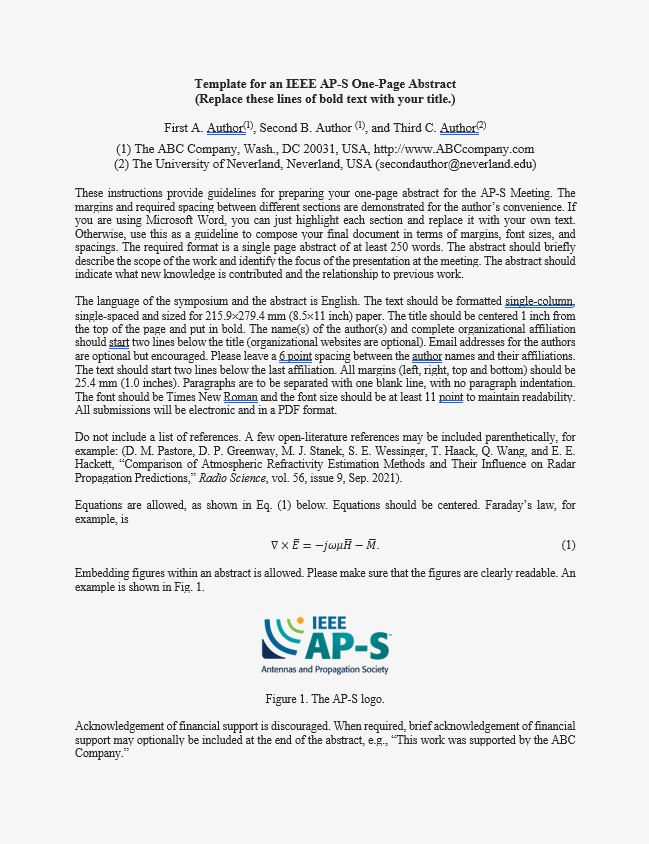
Start an AP-S 1-Page Abstract Submission
Be sure to have your Publish-ready 1-column, 1-page AP-S Abstract ready.
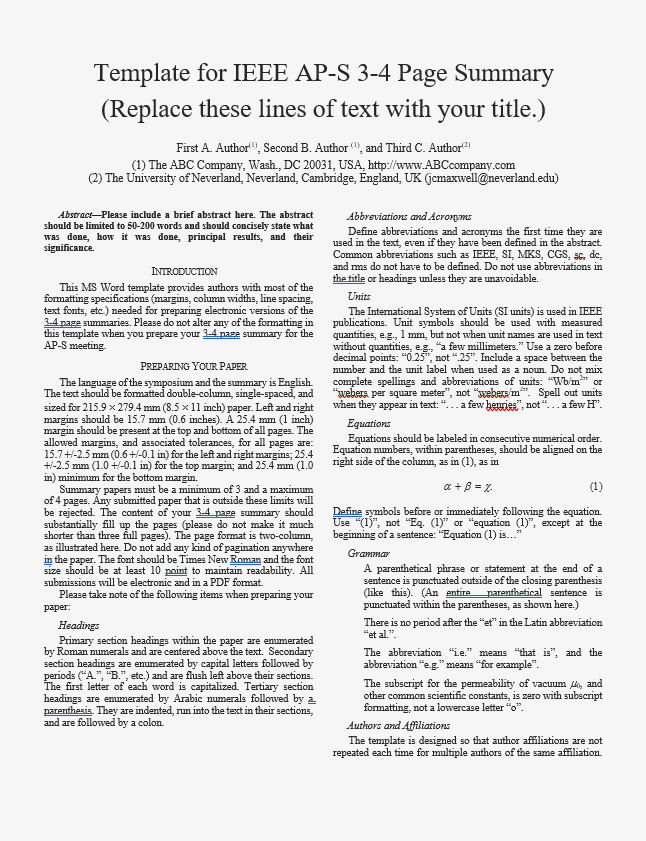
Start an AP-S 3-4 Page Paper Submission
Be sure to have your Publish-ready 2-column, 3-4 page AP-S Paper ready.
Is your URSI submission a 1-page (single-column) abstract, or a 2-page, 2-column paper?
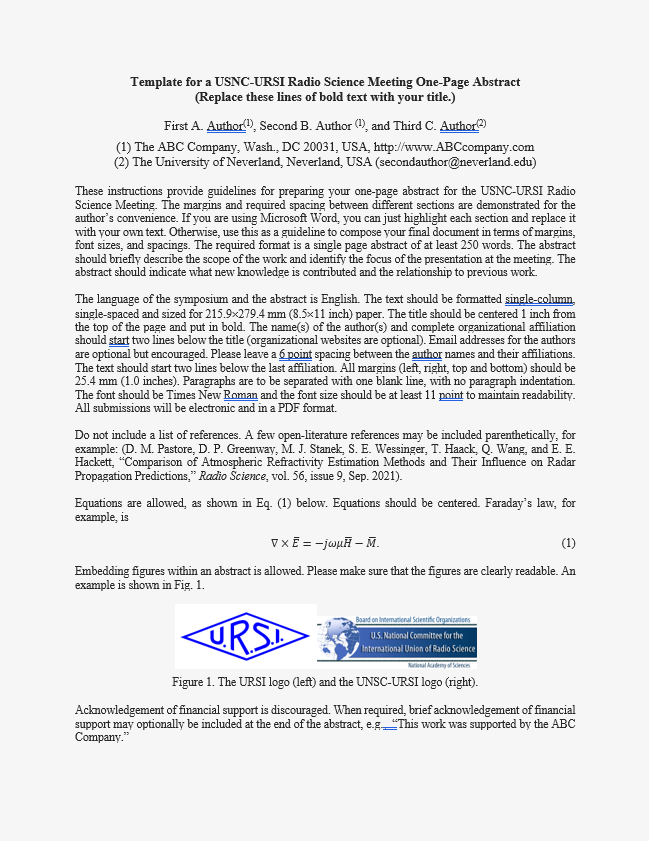
Start an URSI 1-Page Abstract Submission
Be sure to have your Publish-ready 1-column, 1-page URSI Abstract ready.
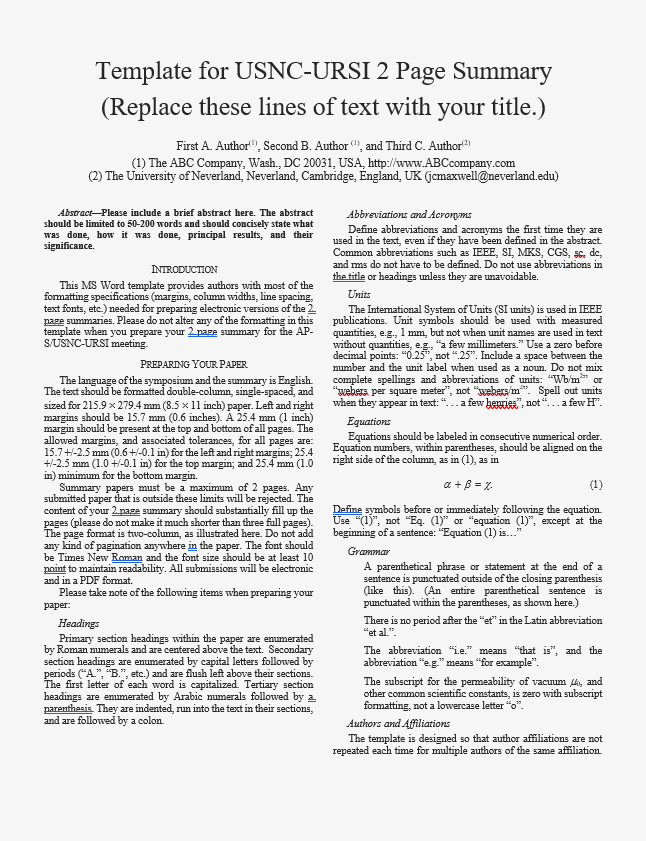
Start an URSI 2-Page Paper Submission
Be sure to have your Publish-ready 2-column, 2-page URSI Paper ready.
AP-S Student Paper Competition Submission
Be sure to have ALL of the required files ready.
| Blind, 2-column, 3-4 page AP-S Paper, NO AUTHOR-IDENTIFYING INFORMATION |  |
This document will be judged for the SPC. You need BOTH this anonymized paper, AND the publish-ready non-anonymized paper. |
| Publish-ready, 2-column, 3-4 page AP-S Paper, WITH FULL AUTHOR LISTING AND REFERENCES |  |
This document will be published in the proceedings, if accepted. You need BOTH this publish-ready paper, AND the anonymized paper. |
| For consideration in the student paper competition, the student must be the only student author and must be first author on the paper. The primary advisor of the student must submit an attestation that the paper is eligible for the competition. |
Do you have ALL of the required files ready?
AP-S Student Paper Competition Submission
Collect the required documents, then return to this page.
| Blind, 2-column, 3-4 page AP-S Paper, NO AUTHOR-IDENTIFYING INFORMATION | |
This document will be judged for the SPC. You need BOTH this anonymized paper, AND the publish-ready non-anonymized paper. |
| Publish-ready, 2-column, 3-4 page AP-S Paper, WITH FULL AUTHOR LISTING AND REFERENCES | |
This document will be published in the proceedings, if accepted. You need BOTH this publish-ready paper, AND the anonymized paper. |
| For consideration in the student paper competition, the student must be the only student author and must be first author on the paper. The primary advisor of the student must submit an attestation that the paper is eligible for the competition. |
AP-S Student Paper Competition Submission
Be sure to have ALL of the required files ready.
| Blind, 2-column, 3-4 page AP-S Paper, NO AUTHOR-IDENTIFYING INFORMATION | |
This document will be judged for the SPC. You need BOTH this anonymized paper, AND the publish-ready non-anonymized paper. |
| Publish-ready, 2-column, 3-4 page AP-S Paper, WITH FULL AUTHOR LISTING AND REFERENCES | |
This document will be published in the proceedings, if accepted. You need BOTH this publish-ready paper, AND the anonymized paper. |
| For consideration in the student paper competition, the student must be the only student author and must be first author on the paper. The primary advisor of the student must submit an attestation that the paper is eligible for the competition. |